
Scientific Form Converter
Convert any number into scientific form — or back to an ordinary decimal. Type 0.000456, 4.56e-4, 4.56 × 10^-4 or 1,250,000 and see standard form, scientific notation, E-notation and engineering notation with SI prefix, rounded to the significant figures you choose.
- Free to use
- No sign-up
- Runs in your browser
Convert to and from scientific form
Scientific Notation Practice Pack
Printable scientific notation practice sheets with answer keys, an SI prefix chart and a significant figures rule card.
- Practice sheets with answers (PDF, DOCX)
- SI prefix chart & sig-fig rules (PDF, XLSX)
Formats: PDF, DOCX, XLSX. Instant download after payment (link valid 72 hours, up to 5 downloads). AI-assisted: the templates were drafted with AI help and reviewed and laid out before publishing.
$3.00 USD, one-time
- Instant download
- 7-day refund
- Secure checkout by Stripe
7-day money-back guarantee. Full refund within 7 days of purchase, even after you download.
Full refund within 7 days — see the refund policy and license.
Free printables
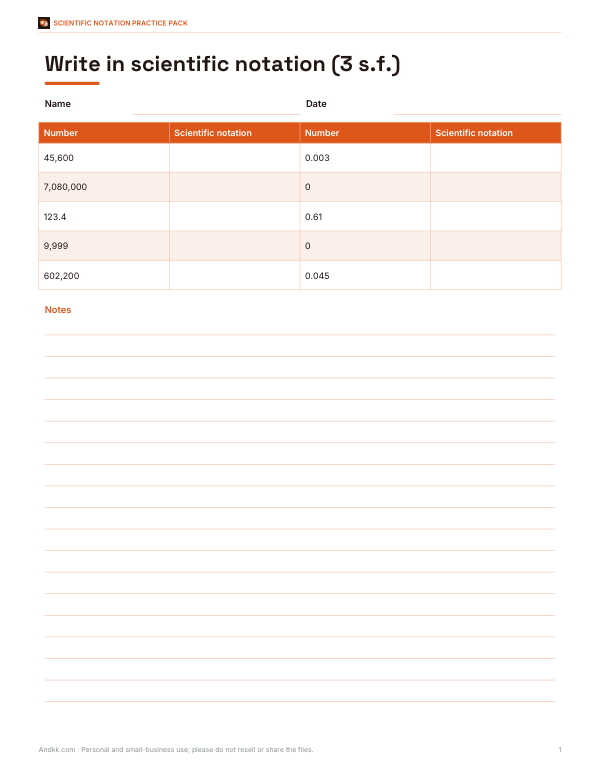
Single sheets you can print right now, no sign-up. The full pack adds every sheet in one download plus the editable files.
What scientific form is
Scientific form — also called scientific notation or standard form in UK schools — writes a number as a value between 1 and 10 multiplied by a power of ten: a × 10ⁿ, where 1 ≤ a < 10 and n is a whole number. The speed of light, 299,792,458 m/s, becomes about 3.00 × 10⁸ m/s; the mass of an electron, 0.000 000 000 000 000 000 000 000 000 000 910 94 kg, becomes 9.1094 × 10⁻³¹ kg. Very large and very small numbers become easy to read, compare and calculate with.
How to convert to scientific form
- Move the decimal point until exactly one non-zero digit is to its left.
- Count how many places you moved it. That number is the exponent.
- If you moved the point to the left (the number was large), the exponent is positive; if you moved it right (the number was small), the exponent is negative.
- Round the first part to the number of significant figures you need.
Example: 0.000456789 — move the point four places right to get 4.56789, so the exponent is −4: 4.56789 × 10⁻⁴, or 4.57 × 10⁻⁴ to three significant figures.
Converting back to a decimal
To turn a × 10ⁿ back into an ordinary number, move the decimal point n places to the right if n is positive, or n places to the left if n is negative, adding zeros as needed. 6.02 × 10²³ has 21 zeros after the 602; 1.6 × 10⁻¹⁹ is 0.000 000 000 000 000 000 16. The converter shows the standard form with thousands separators for large numbers so the digits are easy to count.
E-notation
Calculators, spreadsheets and programming languages write powers of ten with the letter E, meaning “times ten to the power of”. 4.57E-4 is 4.57 × 10⁻⁴, and 3E8 is 3 × 10⁸. You can type E-notation into the converter directly. Note that in spreadsheets, formatting a cell as “Scientific” changes only how it is displayed, not the stored value.
Engineering notation and SI prefixes
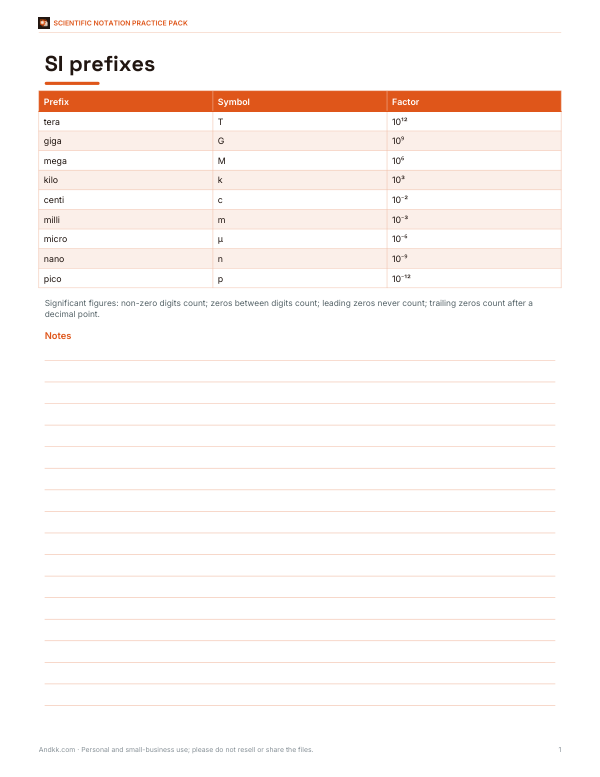
Engineering notation is like scientific notation, but the exponent is always a multiple of three, so the first part is between 1 and 1,000. This lines up with SI prefixes: 4.57 × 10⁻⁴ m becomes 457 × 10⁻⁶ m, which is 457 µm (micrometres). 1.25 × 10⁶ W becomes 1.25 MW.
| Prefix | Symbol | Power |
|---|---|---|
| giga | G | 10⁹ |
| mega | M | 10⁶ |
| kilo | k | 10³ |
| (none) | 10⁰ | |
| milli | m | 10⁻³ |
| micro | µ | 10⁻⁶ |
| nano | n | 10⁻⁹ |
| pico | p | 10⁻¹² |
Significant figures
The first part of scientific notation shows exactly how many significant figures a measurement has, which is one of its main advantages. 1,200 is ambiguous — it may have two, three or four significant figures — but 1.2 × 10³, 1.20 × 10³ and 1.200 × 10³ are clear. Choose the number of significant figures to match the precision of your data: a measurement made to the nearest millimetre should not be reported with more digits than that implies. The converter rounds correctly, carrying into the exponent when needed (9.996 × 10² to three figures becomes 1.00 × 10³).
Worked examples
| Number | Scientific (3 s.f.) | E-notation | Engineering / SI |
|---|---|---|---|
| 1,250,000 | 1.25 × 10⁶ | 1.25E+6 | 1.25 × 10⁶ (1.25 M) |
| 0.000456789 | 4.57 × 10⁻⁴ | 4.57E-4 | 457 × 10⁻⁶ (457 µ) |
| 299,792,458 | 3.00 × 10⁸ | 3.00E+8 | 300 × 10⁶ (300 M) |
| 0.0072 | 7.20 × 10⁻³ | 7.20E-3 | 7.20 × 10⁻³ (7.20 m) |
| 96,485 | 9.65 × 10⁴ | 9.65E+4 | 96.5 × 10³ (96.5 k) |
Calculating in scientific form
Scientific form makes multiplication and division easy: multiply or divide the first parts, then add or subtract the exponents. (3 × 10⁴) × (2 × 10⁵) = 6 × 10⁹, and (8 × 10⁶) ÷ (4 × 10²) = 2 × 10⁴. If the result's first part falls outside 1 to 10, adjust it: 12 × 10³ becomes 1.2 × 10⁴. For addition and subtraction, rewrite the numbers with the same power of ten first, add the first parts, then normalise the result.
Frequently asked questions
How do I write 0.00056 in scientific notation?
5.6 × 10⁻⁴.
What is 3.2E5?
3.2 × 10⁵, which is 320,000.
What is the difference between scientific and engineering notation?
Engineering notation uses exponents that are multiples of three, matching SI prefixes such as kilo, mega and micro.
Is standard form the same as scientific notation?
In UK schools, “standard form” means scientific notation. In the US, “standard form” usually means the ordinary decimal number.
How many significant figures should I use?
Match the precision of your measurements or the question — often three significant figures in school science.
Can I type × symbols?
Yes: 4.56 × 10^-4, 4.56*10^-4 and 4.56e-4 are all accepted.
Why does 1,200 have an ambiguous number of significant figures?
Trailing zeros without a decimal point may or may not be significant. Writing 1.2 × 10³ or 1.200 × 10³ removes the doubt.
How do calculators show very small numbers?
Most switch automatically to E-notation, for example 4.56E-4 or 4.56-04 on older displays, when numbers get too large or small for the screen.
Is a negative exponent a negative number?
No. A negative exponent means a small positive number: 10⁻³ is 0.001. The sign in front of the first part makes the number negative.
What does order of magnitude mean?
The power of ten in scientific notation. Numbers with the same exponent are within a factor of ten of each other.